Published 14 Oct 2026
An 8-day China trip from India fits Beijing (Forbidden City and Great Wall), Xi’an (Terracotta Army) and Shanghai (the Bund and old water towns), joined by high-speed trains. Indians need a visa applied for in person at a Chinese visa centre, so start that first; budget roughly ₹84,000 to ₹1,30,000 per person.
Visa and entry rules for Indians
A visa is required. The Chinese Embassy in India’s pages, which we checked on 14 October 2026, say:
- Where: applications go through the visa application service centres in New Delhi, Mumbai and Kolkata. Maharashtra and Karnataka residents are handled by Mumbai, Bihar, Jharkhand, Odisha, Chhattisgarh and West Bengal by Kolkata, and everyone else by New Delhi. You fill the form online first and then submit in person.
- Appointment: the notice says the appointment requirement was removed from November 2023, so you can submit on any working day.
- Processing: typically 4 working days regular and 3 express. Express and urgent fees are ₹1,800 and ₹2,700 per application.
- Fee: the embassy’s notice of 4 January 2026 extends the visa-fee reduction for Indian passport holders until 31 December 2026. The amounts are published as images we could not read, so we do not quote them. The service centre adds its own charge.
- Documents: a passport valid at least six months with two blank pages, the online form confirmation, two photos (48 mm × 33 mm, taken within six months) and your last Chinese visa, if any. For tourism (L): itinerary, hotel and airline bookings and bank proof of at least ₹1 lakh.
- Fingerprints: short-stay single and double-entry applicants are temporarily exempt, per the embassy’s notice. Anyone applying for a longer or multiple-entry visa may be asked for them.
The embassy pages we read do not state the standard length of stay for an L visa, so check the validity and “duration of each stay” printed on your visa. Start from the embassy’s visa page and its notices; it carries the current rules. Be wary of agents that quote “guaranteed” approvals. The visa centre’s own fees are published, and rules change.
What it costs in rupees
Per person, two sharing rooms, mid-range, 8 days and 7 nights. These are our estimates; the yuan is roughly ₹12, so check the day’s rate.
| Item | Approx. cost |
|---|---|
| Return flight, Delhi, Mumbai or Kolkata | ₹35,000 – ₹55,000 |
| Visa (fee plus service centre charge, estimate) | ₹5,000 – ₹7,000 |
| Hotels, 7 nights (half the room cost) | ₹14,000 – ₹24,000 |
| High-speed trains: Beijing–Xi’an and Xi’an–Shanghai | ₹10,000 – ₹14,000 |
| Food, about ₹1,400 – ₹2,000 a day | ₹10,000 – ₹15,000 |
| Entry tickets (Forbidden City, Great Wall, Terracotta) | ₹6,000 – ₹9,000 |
| eSIM, metro, taxis and extras | ₹4,000 – ₹6,000 |
| Total | ₹84,000 – ₹1,30,000 |
Train fares come from the national operator’s app and vary by seat class and date. Hotels near the metro in Beijing and Shanghai are the largest swing.
Day-by-day itinerary
Day 1: arrive in Beijing
Take the airport express to the city and check in near a metro line. Evening walk around Wangfujing or the hutong lanes near Nanluogu Xiang; eat roast duck.
Day 2: Forbidden City and Tiananmen
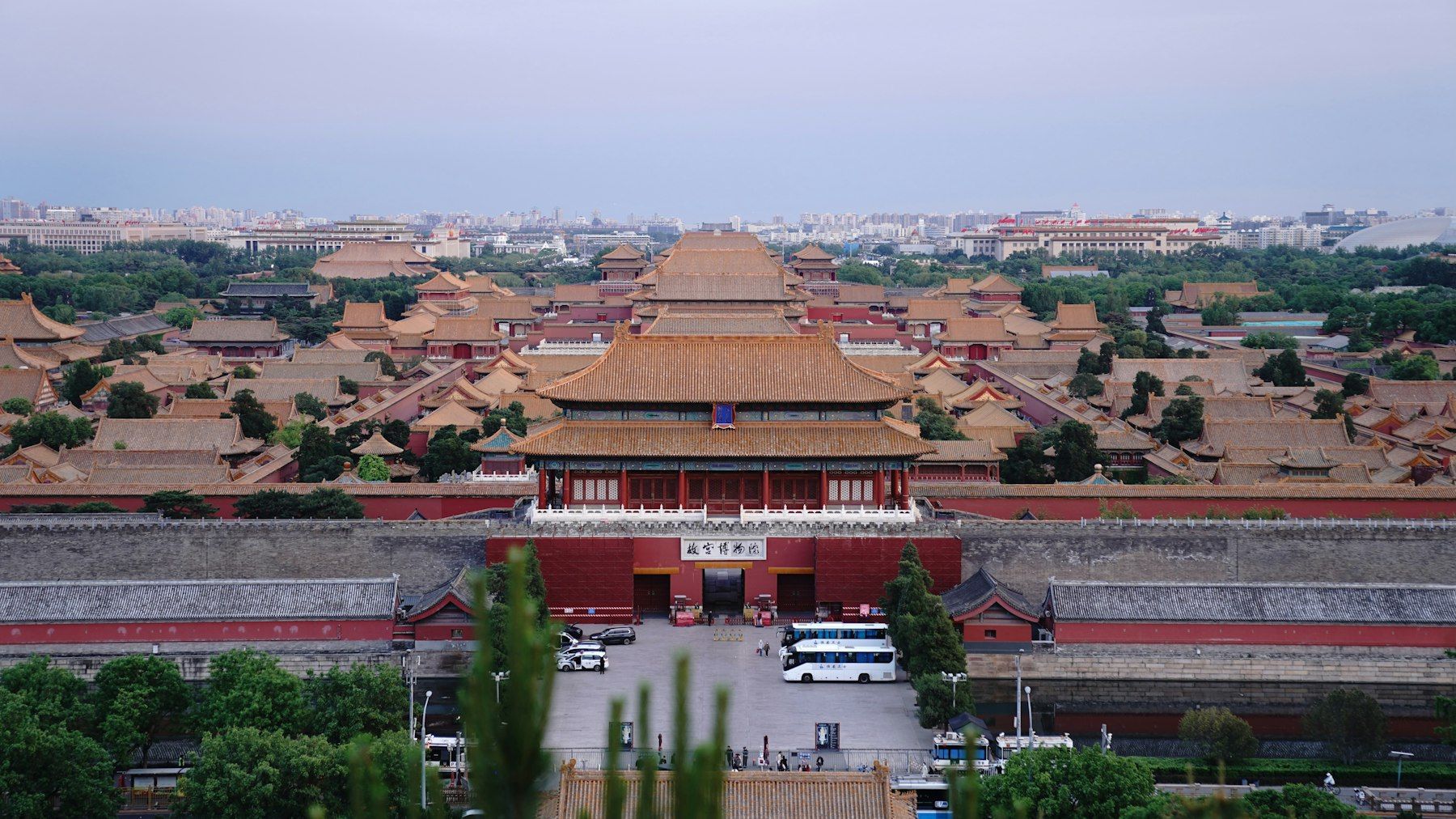
Book Forbidden City tickets online ahead of time, with your passport. They sell out and are checked against ID. Walk Tiananmen Square, then climb Jingshan Park for the view over the yellow roofs shown in the lead photo. Finish at the Temple of Heaven if you have energy.
Day 3: Great Wall
Go to Mutianyu, the most visitor-friendly restored section, or Badaling if you are short on time. Start early. Mutianyu has a cable car and toboggan. Wear grippy shoes; steps are steep and uneven.
Day 4: high-speed train to Xi’an
Take a morning G-series train, about 4 to 5 hours. Spend the evening on Xi’an’s Muslim Quarter and the city wall, which you can cycle. Vegetarians should ask for vegetable-only dishes and no meat stock.
Day 5: Terracotta Army
Go by metro and bus or an arranged car to the Terracotta Warriors, then back for the Big Wild Goose Pagoda at dusk. Allow three hours on site and book tickets online.
Day 6: to Shanghai
Another high-speed train, about 6 hours, so the day is mostly travel. Walk the Bund after dark for the skyline view.
Day 7: Shanghai and a water town
Spend the morning in the old city and Yu Garden, then take a day trip to Zhujiajiao or Suzhou by train. Return for a dinner of xiaolongbao.
Day 8: fly home
Take the Maglev or metro to Pudong airport. Allow three hours for international check-in.
Money, internet and apps
- Payments: UPI is not accepted. Link a Visa or Mastercard to Alipay or WeChat Pay before you fly; most places expect QR payment, and many small vendors do not take foreign cards. Keep some yuan cash.
- The firewall: Google, Gmail, WhatsApp, Instagram and many Western sites are blocked without a VPN. An eSIM that routes traffic abroad (check the provider’s China details) is the simplest fix. Download offline maps and translation packs at home.
- Trains: book via the operator’s app or a reseller; the tickets are checked against your passport.
- Plugs: Type A, C and I sockets are common, at 220 V. Bring a universal adapter.
Best time to go
April to May and September to October are best. Avoid Golden Week (1 to 7 October) and Chinese New Year, when trains sell out and hotels double. Summers are hot, humid and rainy, and Beijing winters are cold, though quieter and cheaper.
Practical tips
- Carry your passport everywhere; hotels, trains and attractions check it.
- Download metro and ride-hailing apps in English-friendly versions before the flight.
- Food: vegetarians can eat tofu and vegetable dishes but ask about meat stock. Indian restaurants exist in Beijing and Shanghai.
- Hotel booking: confirm the hotel can register foreign guests.
Related guides
Short on time? Try the Hong Kong 4-day plan, or the Macau 4-day trip, both without a visa (Hong Kong needs a free online registration). Other East Asia routes: Japan in cherry blossom season, the Taiwan 7-day itinerary and South Korea. More facts are on the China hub.
Frequently asked questions
Do Indians need a visa for China?
Yes. Indian passport holders need a visa before travel, applied for in person at the Chinese Visa Application Service Centre in Delhi, Mumbai or Kolkata. Fill the form online first. The embassy says appointments have not been required since November 2023.
How much is the China visa fee for Indians?
The embassy has extended a reduced visa fee for Indian passport holders until 31 December 2026, but publishes the amounts only as images. Express (₹1,800) and urgent (₹2,700) fees are extra and unchanged. The service centre adds its own charge, so budget about ₹5,000 to ₹7,000 and confirm at submission.
How long does the China visa take for Indians?
The embassy's notice gives about 4 working days for regular and 3 for express processing. Apply at least three weeks before flying so a document query does not cost you your tickets.
Do I need to show a bank balance for the China tourist visa?
The embassy lists, for tourism (L) visas, an itinerary, hotel and airline bookings and bank proof of at least 1 lakh rupees. Carry recent statements and refundable bookings; do not pay for non-refundable tickets before approval.
How much does an 8-day China trip cost from India?
Roughly ₹84,000 to ₹1,30,000 per person for return flights, visa, seven hotel nights shared between two, high-speed trains, food and entry tickets. Flights and hotel class decide where you land in the range.
Can I use UPI, Google Maps or WhatsApp in China?
UPI does not work in China. Alipay and WeChat Pay accept foreign cards for tourists, so set one up before you fly. Google, WhatsApp and Instagram are blocked without a VPN or an eSIM that routes traffic through another country, so install apps and offline maps beforehand.
What is the best time to visit China from India?
April to May and September to October: mild, clearer skies, fewer storms. Avoid 1 to 7 October (Golden Week) and Chinese New Year, when trains sell out and prices spike. Summers are hot and humid, winters in Beijing are cold and dry.