Published 14 Oct 2026
Six days is enough for Sarajevo’s old bazaar and museums, the drive to Mostar’s Old Bridge and a day among the Herzegovina waterfalls. Indians need a visa for Bosnia and Herzegovina unless they already hold a valid multiple-entry Schengen, EU or US visa, and a mid-range trip costs roughly ₹74,000 to ₹1.19 lakh per person.
Visa and entry rules for Indians
Indian passports need a Bosnian visa unless you hold a qualifying visa from elsewhere. We checked these sources on 14 October 2026:
- Visa-free with a Schengen, EU or US document. The Council of Ministers’ visa information page says holders of a valid multiple-entry visa, or a residence permit, issued by Schengen states, EU member states or the USA can enter, transit and stay without a Bosnian visa, as long as they travel on a passport.
- Stay limits. A single uninterrupted stay may not exceed 30 days, with 90 days allowed in any 180-day period, and the stay must fall within the validity of the visa or permit.
- India’s own view. The Indian Embassy in Budapest repeats the same rule for Indians: a multiple-entry Schengen visa, or a Schengen, EU or US residence permit, and a Bosnian visa for everyone else.
- Everyone else applies abroad. The official page says visas are issued at Bosnian diplomatic and consular missions abroad. It lists a €31 fee for a single-entry visa, €57 for multiple-entry up to 90 days, one passport photograph, and an invitation letter for a private visit or a business invitation for business travel.
What we could not verify: the page does not state processing times, visa validity or the invitation requirement for ordinary tourists with hotel bookings, and the sections on consular offices were empty. If you do not hold a qualifying visa, contact the nearest Bosnian mission before booking. Border police can also check your documents on entry, so carry the visa, hotel bookings and a return ticket. Use only government or embassy sites, and avoid agents promising “Bosnia visa on arrival”, which the official page does not mention.
What it costs in rupees
Per person, two sharing a room, mid-range, six days and five nights. These are our estimates, not quoted fares. Prices are in rupees at roughly ₹50 to the Bosnian mark.
| Item | Approx. cost |
|---|---|
| Return flights, India to Sarajevo, one stop | ₹42,000 – ₹65,000 |
| Visa (₹0 on a qualifying Schengen or US visa) | ₹0 |
| Hotels or apartments, 5 nights (half room) | ₹10,000 – ₹18,000 |
| Food, about ₹1,500 – ₹2,500 a day | ₹9,000 – ₹15,000 |
| Trains, buses and city taxis | ₹5,000 – ₹8,000 |
| Day tour or driver, entries, cable car | ₹5,000 – ₹9,000 |
| eSIM, travel insurance, tips | ₹2,500 – ₹4,000 |
| Total | ₹74,000 – ₹1,19,000 |
The low end uses a 3-star hotel or guesthouse in Baščaršija, buses between cities and a shared day tour. The high end adds a private driver for Herzegovina, a boutique hotel in Mostar’s old town and peak-season flights. If you need to apply for a Bosnian visa, add the €31 fee plus courier and photo costs.
Getting there and getting around
There are no non-stop flights from India to Sarajevo. Most itineraries use one stop in Istanbul, Doha, Dubai or a European hub, and take roughly 10 to 14 hours. Compare fares on the airline sites, and check whether your connecting airport needs a transit visa for Indian passport holders.
Sarajevo’s old town is walkable, and trams and trolley buses cover the rest. Between cities, buses are the most flexible option, while the scenic Sarajevo to Mostar train runs only a few times a day, so check the current timetable. A rental car is possible, but mountain roads and different driving rules make a driver the easier choice for Herzegovina.
Day-by-day itinerary
Day 1: arrive in Sarajevo and Baščaršija
Check in near the old town and walk through Baščaršija, the Ottoman-era bazaar with copper workshops, the Sebilj fountain and cafés serving Bosnian coffee. Have dinner on a nearby side street and try ćevapi or a vegetable pita.
Day 2: Sarajevo’s history
Walk along the river past the Latin Bridge and the Vijećnica (the old city hall), then visit the Gazi Husrev-beg Mosque in the old town. In the afternoon, visit the Tunnel of Hope museum near the airport, which tells the story of the 1990s siege, and keep the evening free for the bazaar.
Day 3: Sarajevo views and a day to spare
Take the Trebević cable car or a taxi to the hills above the city for views over the valley, then spend the afternoon in cafés and bookshops, or at the Yellow Fortress at sunset. If you are travelling with a vegetarian, this is a good day to try one of the city’s Indian or vegan restaurants.
Day 4: Konjic, Jablanica and Mostar
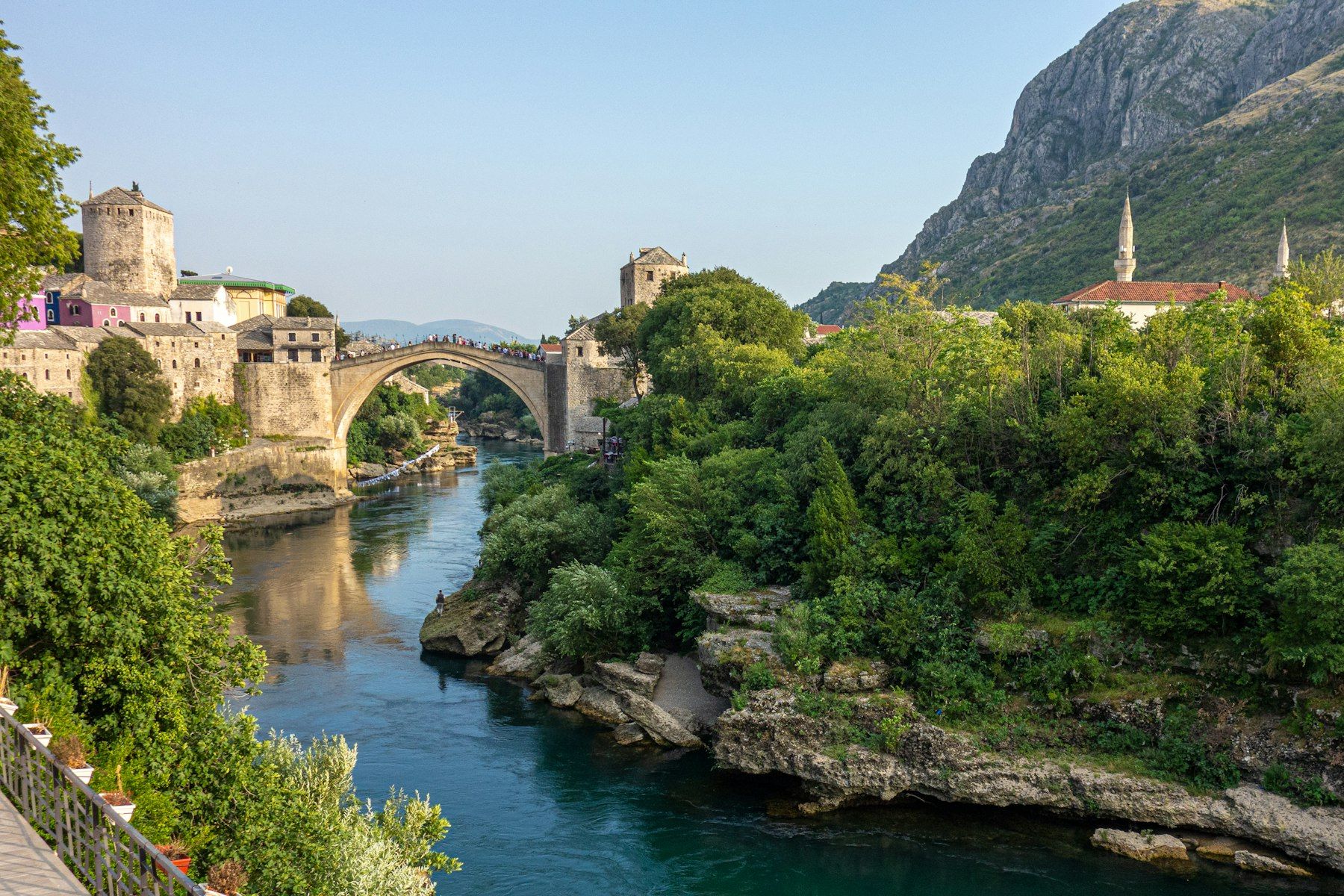
Leave Sarajevo in the morning, either on the scenic train or with a driver. Stop at Konjic, known for its old stone bridge over the Neretva, and at Jablanica on the lake, before arriving in Mostar by afternoon. Walk down to Stari Most, the stone arch bridge in our photo, and across to the east bank’s cobbled lanes of Kujundžiluk.
Day 5: Blagaj, Počitelj and Kravice
Spend the day with a driver or on a small-group tour. Visit the Blagaj Tekke, a Sufi house set under a cliff at the source of the Buna river, then the hillside village of Počitelj, and end at the Kravice waterfalls, a wide curtain of falls on the Trebižat river where swimming is possible in warm months. Reported entry fees are small, but confirm them locally.
Day 6: Mostar morning and departure
Return to the Old Bridge before the day-trippers arrive and have breakfast in the old town. Transfer to Sarajevo by bus, train or car for your flight, or fly from Mostar’s small airport if your route allows, which is worth checking when you book.
Food for Indian travellers
Bosnian food is heavy on grilled meat, but vegetarians can eat well on burek with cheese or spinach, pita, soups, kajmak with bread, grilled peppers and bean dishes. The country’s dining culture is largely Muslim, so most restaurants offer halal meat, and pork is not served at traditional places. Sarajevo has a few Indian restaurants and several vegan cafés. Alcohol is served in restaurants in the cities.
Best time to go
May to June and September to October are the best months, with mild weather, green hills and fewer crowds. July and August are very hot in Mostar, with the Old Bridge divers on summer weekends. December to February is cold and snowy in Sarajevo, and some rural attractions close.
Practical tips
- Money: The convertible mark is pegged to the euro, so a forex card with euros is useful, and cards are accepted in most hotels and restaurants. Carry cash for small cafés, markets and taxis, and do not rely on UPI.
- Connectivity: Buy an eSIM before you fly, or a local SIM in Sarajevo.
- Plugs: Bosnia uses European two-pin Type C and F plugs, so carry an adapter.
- Schengen rules: Bosnia is not part of the Schengen area, so check that your Schengen visa allows re-entry if you plan to return to a Schengen country after the trip.
- Dress: Cover shoulders and knees when entering mosques, and remove shoes at the door.
- Landmines: Stay on marked paths and trails in rural areas, and do not walk into unmarked fields or abandoned buildings.
Related guides
Many travellers combine Bosnia with other Balkan countries, so see the Serbia 5-day plan, the Montenegro 6-day plan or the Croatia 7-day plan. Entry rules and facts are on the Bosnia and Herzegovina hub.
Frequently asked questions
Do Indians need a visa for Bosnia and Herzegovina?
Yes, unless you hold a qualifying document. The Bosnian Council of Ministers' visa page, checked on 14 October 2026, says holders of a valid multiple-entry visa or a residence permit issued by Schengen states, EU member states or the USA may enter, transit and stay without a Bosnian visa. Indians without one need a visa from a Bosnian mission abroad.
Can I go to Bosnia with a Schengen visa from India?
Yes, if the Schengen visa is multiple-entry and still valid. The official page says a valid multiple-entry Schengen visa is enough, subject to a check by border police. A single-entry Schengen visa is not mentioned as qualifying, so do not rely on one.
Does a US visa work for entering Bosnia?
Yes. The same official page names a valid multiple-entry visa or residence permit issued by the USA alongside the Schengen and EU ones. The page does not list the UK, so a UK visa alone is not covered by the text we read.
How long can an Indian stay in Bosnia without a visa?
A single uninterrupted stay may not exceed 30 days, with up to 90 days in total in any 180-day period, and the stay must fall within the validity of the visa or permit you entered on. Six days is well inside this.
How much does a 6-day Bosnia trip cost from India?
Roughly ₹74,000 to ₹1.19 lakh per person with two sharing a room, covering return flights with a stop, five nights in a 3-star hotel or apartment, food, trains and buses, a day tour and entries. Flights are about half the cost, and Bosnian food and rooms are cheap by European standards.
How do you get from Sarajevo to Mostar?
By bus or by car, in about 2.5 to 3 hours, or by train on the scenic line through Konjic and Jablanica. The Bosnian railways timetable runs few services a day, so check it on the day you plan to travel. A driver or a day tour from Sarajevo lets you stop at Konjic, Počitelj and the Kravice waterfalls on the way.
Is Bosnia good for vegetarians and Indian travellers?
Manageable. Bosnian food is meat-heavy, but burek with cheese or spinach (sirnica, zeljanica), pita, grilled vegetables, kajmak, beans and salads are common, and Sarajevo has Turkish, Indian and vegan places. Ask for vegetable pita and say 'bez mesa', which means without meat.
What is the best time to visit Bosnia?
May to June and September to October, when the weather is mild and the waterfalls and trails are at their best. July and August can be very hot in Mostar, while December to February brings snow to Sarajevo and the nearby ski mountains.